Video Integration — boost the buzz around your online fundraising campaign
Time-saving – thoughtful automations save dozens of hours over your campaign
One-Click Checkout — our system will automatically charge the lucky winner
Text Message Notifications — keep your bidders engaged with text message notifications
Want to build an effective fundraising campaign?
Our team is here to give you more details and guides on how to grow your fundraiser.
Book a demo →
What is a Donor-Advised Fund (DAF) and how does it work?
By Team BetterWorld on
Donor-advised funds are one of the fastest-growing channels in American philanthropy. If you work in the nonprofit sector, advise donors, or plan your own charitable strategy, you will likely encounter DAFs regularly.
For nonprofits, this growth is important. A large and increasing share of charitable dollars now moves through DAFs, so understanding how they work can directly impact your fundraising results.
If your donation forms do not clearly support DAF gifts, you may miss out on donations that donors are ready to give.
Let’s find out what nonprofits need to know about donor-advised funds, how they work, and what steps you can take to make sure your organization is ready to receive DAF gifts.
What is a Donor-Advised Fund (DAF)?
A donor-advised fund (DAF) is a charitable giving account set up under a public charity. The Internal Revenue Service defines a DAF as a separately identified fund or account that is maintained and operated by a 501(c)(3) sponsoring organization.
Once a donor makes a contribution, the sponsoring organization takes legal control of the assets. The donor retains advisory privileges, meaning they can recommend how the money is invested and which nonprofits should receive grants.
In fiscal year 2024, the Donor Advised Fund Research Collaborative reported:
- 1,485 DAF sponsors
- 3.56 million DAF accounts
- $326.45 billion in total assets
- $89.64 billion in contributions
- $64.89 billion in grants
To understand how quickly this space is growing, consider that the National Philanthropic Trust reported $251.52 billion in DAF assets in 2023, along with a 23.9% payout rate using its calculation method.
Key terms to keep in mind:
- Sponsoring organization: The 501(c)(3) public charity that runs the DAF and legally owns the assets.
- Donor/donor advisor: The person (or entity) who funded the DAF and can recommend grants and investments.
- Advisory privileges: The donor’s ability to recommend grants and investments; recommendations are not legally binding but rarely ignored.
- Irrevocable contribution: Money or assets placed in a DAF generally can’t be taken back by the donor.
- Grant: A payment from the sponsor to an eligible nonprofit (or other eligible recipient) based on the donor’s recommendation.
- Qualified organization: An eligible charitable recipient under IRS rules.
What are the different types of donor-advised fund sponsors?
- Community foundations: Place-based public charities that often combine DAFs with local nonprofit knowledge and other funds (like designated or field-of-interest funds).
- National sponsors (often commercially affiliated): Large public charities that run DAF programs at scale, sometimes linked to major financial institutions.
- Single-issue sponsors: Public charities focused on a specific cause or institution type (for example, faith-based, higher education, or healthcare).
What are the benefits of DAFs for donors?
A donor-advised fund provides several key benefits. Donors receive an upfront tax deduction in the year they contribute, even if they distribute the funds later. They can also donate appreciated assets, such as stocks, which may help reduce capital gains taxes.
A DAF allows donors to support multiple nonprofits from a single account while keeping funds invested until they are ready to grant. It also offers optional anonymity and requires far less administration than starting a private foundation, since the sponsoring organization handles compliance and reporting.
How nonprofits can increase Donor-Advised Fund (DAF) gifts
Here are the most effective strategies nonprofits can use to quickly grow DAF support.
Top strategies that increase DAF gifts:
- Put a DAF option on your main donation page and make it easy to find.
- Add a DAF tool (like a DAF widget) so a donor can start a grant recommendation without leaving your site.
- Run a short “DAF push” during peak giving windows (especially year-end): remind donors that a DAF lets them take a current-year deduction and grant later.
- Train gift officers on DAF rules (benefits, ticket/membership limits, and “who to thank”).
- Build relationships with local community foundations and donor advisors.
- Review your gift log for sponsor names and tag those donors as “DAF users.”
What should nonprofits say in emails and landing pages to prompt DAF gifts?
Nonprofits can use clear prompts in emails and landing pages to encourage DAF gifts. For example: “Have a donor-advised fund? Recommend a grant to [NONPROFIT NAME] today—use our EIN: [EIN].”
You can also say, “Already funded your DAF? A grant recommendation takes minutes and can be sent by check or electronically.”
It’s also helpful to clarify guidelines. “DAF grants must be fully charitable (no tickets or benefits). If you’re attending our event, please pay your ticket separately.” You may add, “Giving from a DAF can be anonymous. If you want us to thank you, please include your name with the grant recommendation.”
And for program-specific support: “DAF donors: You can support [PROGRAM] by adding a designation note in your grant recommendation.”
Identify DAF prospects in your donor list
You can identify DAF prospects in your donor list by reviewing how past gifts were received.
Look for contributions that arrived from major DAF sponsors, since the sponsor’s name typically appears on the check or transfer. Common names include Fidelity Charitable, Schwab Charitable, Vanguard Charitable, and DAFgiving360.
You should also look for donors who make large gifts, give in December, or ask about stock gifts. Add a “Do you have a DAF?” question to your forms and surveys, then tag those records in your CRM.
It’s also helpful to track donors who give appreciated assets, as this is a common DAF use case.
Let us help you raise more! Use BetterWorld’s free, easy fundraising tools!
How can your nonprofit build a DAF-friendly donor experience?
The fixes below follow common friction points highlighted by DAF tools and sponsor policies (especially around donor identification, eligibility details, and payment flow).
Friction point donors hit | What it looks like | Simple fix for nonprofits |
Donor can’t find your EIN | Donor opens their DAF portal and can’t match your org | Put EIN + legal name in a dedicated DAF section on your site |
DAF option is buried | Donor never sees DAF giving as an option | Place DAF giving near other payment options and in your year-end appeal |
Donor gets “benefit” confusion | Donor tries to pay for gala tickets or auction items with DAF | Add a short note: “DAF grants can’t buy tickets/benefits; pay those separately.” |
Gift arrives anonymous | You receive the grant, but can’t thank the donor | On your DAF page, ask donors to include their name/email in the grant note |
Designations get messy | Grant arrives with an unclear purpose | Provide a short list of standard designations donors can copy |
Power your DAF fundraising with BetterWorld’s DAF Pay
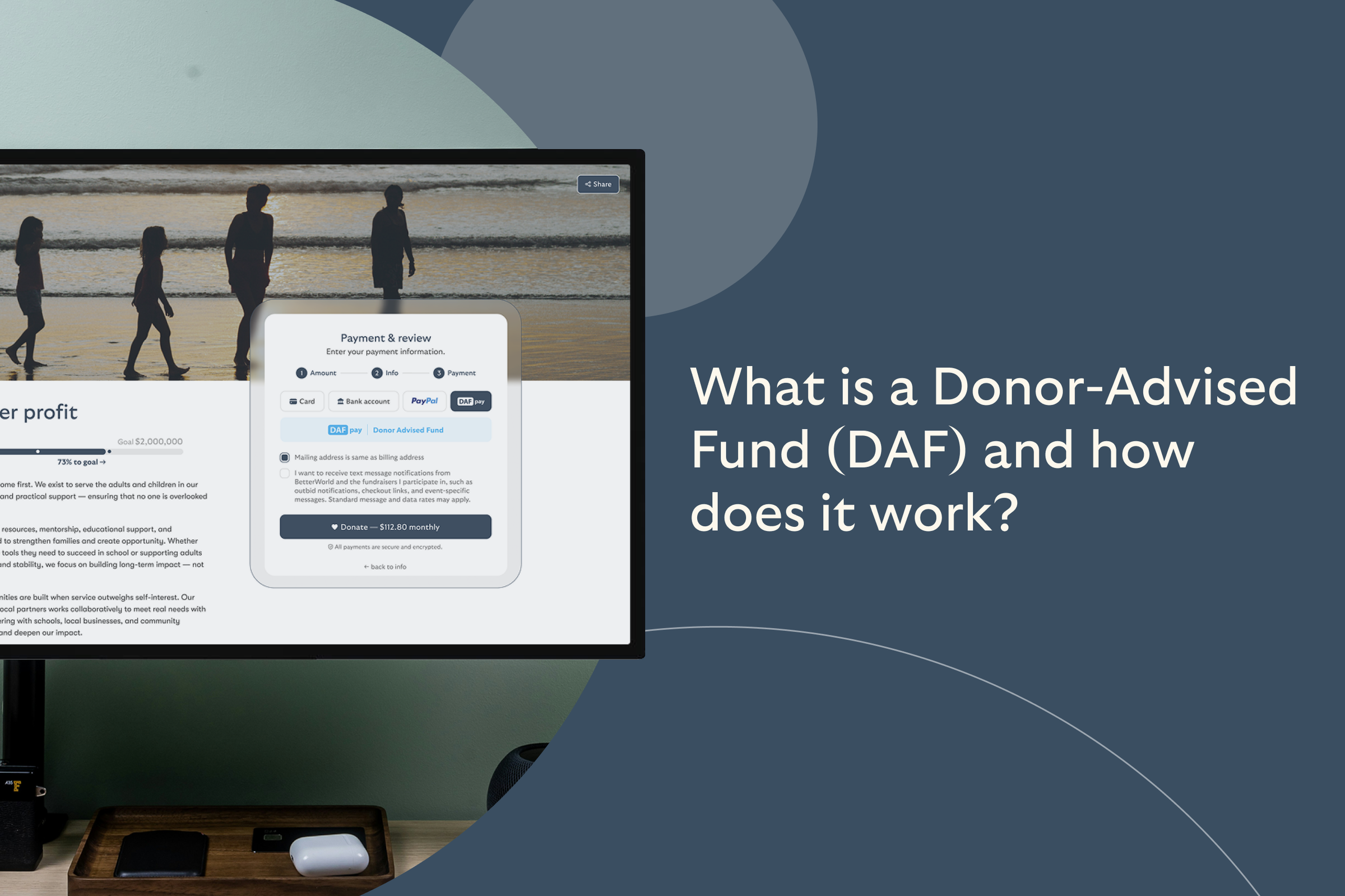
Ready to make Donor-Advised Fund giving simple and seamless? BetterWorld is launching DAF Pay to help nonprofits accept DAF grants directly through their platform.
If you want to remove friction, capture more DAF gifts, and make it easier for donors to give, connect with the BetterWorld team today and see how DAF Pay can support your fundraising strategy.
FAQs
1. What can donors contribute to a DAF?
Donors can contribute cash, publicly traded securities, long-term appreciated assets, certain restricted or control stock, and, in some cases, cryptocurrency. Accepted assets depend on the sponsor’s policies.
2. Is there a deadline to use DAF funds?
There is no federal rule requiring a specific payout timeline. However, many sponsors have inactive or minimal grant policies if funds remain unused for too long.
3. What happens to a DAF after death?
You can name successors to continue recommending grants or designate charities to receive the remaining balance. If no plan is in place, the sponsoring organization distributes the funds according to its policies.
4. Can you give to a church from a DAF?
Yes. You can recommend a grant from a donor-advised fund to a church or other IRS-qualified 501(c)(3) public charity. The sponsoring organization will check that the church qualifies under tax rules before approving the distribution.
5. How long does it take to receive a DAF grant?
Most DAF grants are processed and received within one to three weeks after the donor submits the recommendation, although some may take longer depending on the sponsor.
6. Who typically uses DAFs?
DAFs are used by donors with appreciated assets such as stocks or mutual funds. They are also popular with families who want a shared giving plan and a way to name successors, as well as individuals working with financial advisors. Many people use DAFs during high-income years to support multiple nonprofits with less paperwork.

Join 105,000+ amazing nonprofits, organizations, and fundraisers on BetterWorld

Let our FREE fundraising tools help you raise more funds with less effort