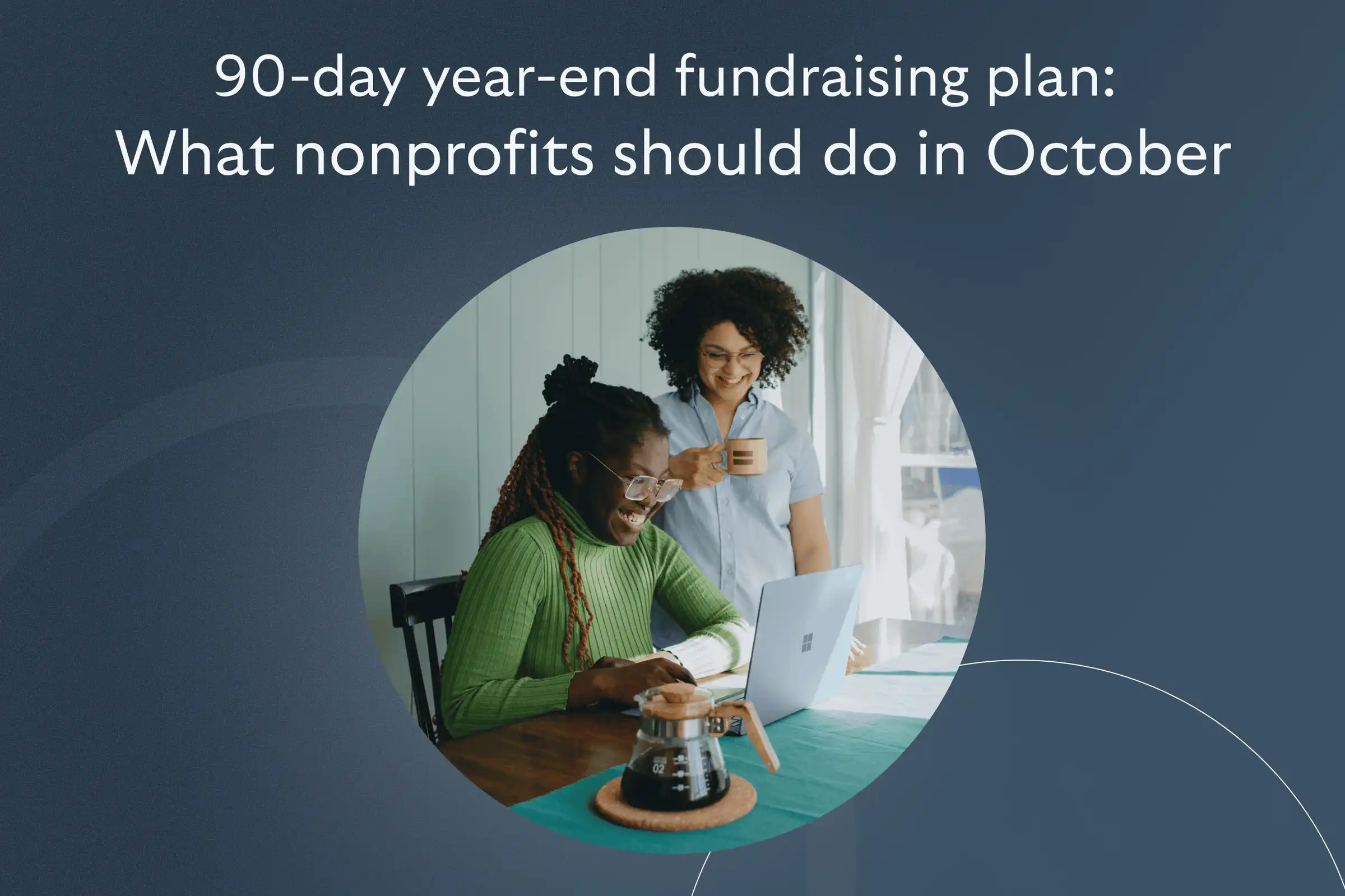
90-day year-end fundraising plan: What nonprofits should do in October
Year-end fundraising may peak in December, but the work should start much earlier. October is when nonprofits can turn plans into campaign pages, donor segments, emails, direct mail, and clear team responsibilities.
The financial reason to act now is clear. Nonprofits in the M+R Benchmarks study received 37% of their 2025 online revenue in December. December 31 alone accounted for 4% of annual online revenue.
A simple October-to-December plan can keep the busiest fundraising season manageable:
October: Build.
November: Activate.
December: Convert and close.
Your 90-day year-end fundraising plan
October: Review past performance, set goals, segment donors, secure a match, build your campaign, prepare appeals, and test your giving tools.
November: Thank and reconnect with supporters, start campaign storytelling, activate ambassadors, and prepare for GivingTuesday.
December: Thank GivingTuesday donors, shift into year-end giving, increase outreach as December 31 approaches, and follow up quickly after each gift.
90-day year-end fundraising timeline at a glance
When | Main priority | Key action |
Oct. 1–7 | Review and set goals | Analyze last year and set campaign targets |
Oct. 8–14 | Segment and build | Organize audiences and finalize the campaign story |
Oct. 15–21 | Create | Build the donation experience and campaign assets |
Oct. 22–31 | Test and schedule | Finish appeals and test the donor journey |
Nov. 1–10 | Steward | Thank and reconnect before asking |
Nov. 11–20 | Warm up | Start storytelling and activate supporters |
Nov. 21–30 | GivingTuesday prep | Finalize launch plans and early gifts |
Dec. 1 | GivingTuesday | Launch, communicate, and track results |
Dec. 2–7 | Thank and pivot | Thank donors and shift year-end messaging |
Dec. 8–15 | Year-end appeal | Launch the main December ask |
Dec. 16–23 | Build momentum | Share progress and impact |
Dec. 24–28 | Prepare final push | Segment audiences and prepare deadline appeals |
Dec. 29–31 | Close strong | Run the final year-end countdown |
October: Build your year-end fundraising campaign
October should carry most of the preparation. The goal is to enter November with your strategy, campaign page, donor groups, content, and giving experience ready.
October 1–7: Review last year and set your goals
Review your previous results. Look at total year-end revenue, number of donors, new and returning donors, average gift, recurring gifts, GivingTuesday results, December 31 results, and your strongest fundraising channels.
GivingTuesday recommends setting goals from your own baseline and focusing on three to five meaningful measures rather than tracking everything.
Set your 2026 targets. Choose one main revenue goal. Add supporting goals for areas such as new donors, recurring donors, reactivated donors, major gifts, peer-to-peer participation, or matching gifts.
Decide how GivingTuesday fits. GivingTuesday 2026 falls on Tuesday, December 1.
Smaller teams do not necessarily need separate GivingTuesday and year-end campaigns. One core story can continue through December 31. Update the message and urgency as the campaign moves forward.
October 8–14: Segment donors and finalize your campaign story
Build your donor segments. Start with current donors, lapsed donors, major donors, monthly donors, first-time donors, volunteers who have not donated, and previous GivingTuesday donors.
A donor who gave last December should not receive the exact same message as someone who joined your list last week.
Choose one clear campaign story. Answer four questions:
- What problem needs attention?
- What will donations support?
- Why does support matter now?
- What can a specific gift help accomplish?
Secure a matching gift. Approach a major donor, board member, business partner, or several donors who can combine their gifts. Confirm the amount, deadline, conditions, and recognition before you promote the match.
Gather your impact material. Collect program results, photos, videos, donor stories, community stories, quotes, and year-to-date outcomes now. Your team should not be searching for campaign assets in late December.
October 15–21: Build the giving experience
Create or update your year-end campaign page. Include a clear fundraising goal, simple headline, impact-focused message, suggested giving amounts, matching-gift details, recurring giving, and one obvious CTA.
Test mobile and desktop giving. Mobile devices accounted for 52% of nonprofit website visits in the M+R 2026 study. Mobile visitors completed donation pages at a lower rate than desktop visitors, which makes a simple mobile experience especially important.
Test the form on both devices. Remove unnecessary fields. Check links, payment options, receipts, and the full checkout process.
Make recurring giving visible. Monthly giving accounted for 27% of online revenue among organizations in the M+R study in 2025.
Do not bury the monthly option. Give donors a clear choice during checkout.
Check other ways supporters can give. Depending on your organization, these may include credit or debit cards, ACH, digital wallets, donor-advised funds, and stock gifts.
DAF revenue among M+R participants increased 44% in 2025, while the number of DAF gifts increased 23%.
October 22–31: Write, test, and schedule your campaign
Build your communication calendar. Map your stewardship message, GivingTuesday teaser and launch, GivingTuesday updates, December appeal, mid-month progress message, final December appeals, and thank-you communications.
Not every nonprofit needs the same number of messages. Build the schedule around your audience and normal communication cadence.
Write the core emails before November. Email generated 11% of online revenue among M+R participants in 2025. Nonprofits raised an average of $54 for every 1,000 fundraising emails sent.
Prepare your stewardship email, GivingTuesday messages, main year-end appeal, progress update, December 31 appeal, and donor thank-you.
Plan direct mail now if you use it. Direct mail still has a place in year-end fundraising. M+R participants saw direct-mail revenue increase 9% in 2025, with an average gift of $120. Mailings to active donors returned an average of $4.51 for every $1 spent.
Coordinate mail and digital appeals around the same campaign story instead of treating them as separate campaigns.
Prepare ambassador content. Give board members, volunteers, and peer-to-peer fundraisers campaign links, sample messages, social posts, images, key dates, and a clear goal. GivingTuesday also recommends providing ambassadors with ready-to-share materials.
Build the thank-you before the ask. Prepare the immediate donor thank-you, first-time donor welcome, major-donor follow-up, and campaign results message.
Then make a real test donation. Check the campaign page, form, payment process, receipt, thank-you email, tracking, peer-to-peer links, and match display.
November: Activate your audience
November 1–10: Lead with stewardship
Thank supporters before asking again.
Share an impact update. Make donor thank-you calls. Ask board members to contact key supporters. Reconnect personally with lapsed and major donors.
This gives your year-end campaign a warmer starting point than opening November with another donation request.
November 11–20: Start warming up the campaign
Begin sharing the story behind your year-end goal.
Use program stories, staff or volunteer voices, behind-the-scenes content, and specific examples of what donations can accomplish.
Activate board members and ambassadors too. Give them campaign links, launch dates, suggested messages, and clear actions.
Reconfirm the amount, timing, and conditions of any GivingTuesday match.
November 21–30: Prepare for GivingTuesday
GivingTuesday is December 1, 2026.
Send your save-the-date reminder. Schedule the launch and progress updates. Prepare your matching-gift messages and final-hours appeal. Secure early gifts where possible, and test the donation experience again.
December: Convert attention into year-end giving
December 1: Run your GivingTuesday campaign
Launch early. Activate ambassadors. Promote your match. Share real milestones during the day. Respond to donor questions and track campaign performance.
Finish with a clear final-hours appeal instead of repeating the same message all day.
December 2–7: Thank donors and pivot
Thank GivingTuesday donors within 48 hours. Share the campaign result and explain what their support can accomplish.
Update your campaign page, homepage, social profiles, and email messaging so they no longer read like December 1 is still approaching.
People who already gave should receive gratitude and impact messages instead of every new fundraising ask.
Raise more. Keep more.
Do more good.
Raise more with BetterWorld December 8–15: Launch your main year-end appeal
Your appeal should clearly state the need, goal, impact, December 31 deadline, and next action.
Contact major donors personally where appropriate. Remind supporters about the giving methods available to them.
December 16–23: Show progress
Give supporters a specific reason to pay attention again.
Instead of saying, “Help us reach our goal,” show the actual gap:
$72,000 raised. $28,000 left to reach our $100,000 goal.
Share campaign milestones, program stories, donor impact, videos, and volunteer voices. Keep previous donors in a separate segment when possible.
December 24–28: Prepare your final push
Identify previous year-end donors, lapsed donors, engaged subscribers, major-gift prospects, and previous GivingTuesday donors who have not yet given.
Prepare your December 29–31 messages around a real reason to act now. That could be the year-end deadline, remaining match, campaign gap, or specific program need.
December 29–31: Close strong
The final days matter. Nonprofits in the M+R study received 10% of annual online revenue during the final week of 2025, with 4% arriving on December 31 alone.
Use real urgency. Share the remaining goal or match. Make the December 31 deadline clear.
Have someone available to help with larger gifts, donor-advised fund questions, payment issues, and receipts.
Year-end fundraising plan checklist
By this date | Your nonprofit should have... |
Oct. 7 | Goals and KPIs set |
Oct. 14 | Donors segmented and campaign story chosen |
Oct. 21 | Donation experience built |
Oct. 31 | Appeals, thank-yous, direct mail, and calendar ready |
Nov. 20 | Audience warmed up and ambassadors activated |
Nov. 30 | GivingTuesday campaign ready |
Dec. 7 | GivingTuesday donors thanked and messaging updated |
Dec. 15 | Main year-end appeal launched |
Dec. 28 | Final audience segments and appeals ready |
Dec. 31 | Final year-end push completed |
Turn your 90-day plan into one connected campaign with BetterWorld
A year-end plan becomes easier to manage when campaign pages, donor activity, recurring gifts, peer-to-peer fundraising, receipts, and reporting are connected rather than spread across separate systems.
BetterWorld brings fundraising tools into one platform and dashboard, while our donation tools support recurring gifts, automatic receipts, real-time gift tracking, and multiple ways to run campaigns.
Our peer-to-peer tools also give supporters individual fundraising pages while keeping gifts and donor activity connected in one dashboard.
For a small or busy nonprofit team, that fits the same principle behind this 90-day plan: build once, activate your community, then carry the momentum all the way through December 31.
Request a demo or sign up now for free!
FAQs
1. When should nonprofits start year-end fundraising?
October is a practical starting point for a structured campaign. It gives your team time to set goals, segment donors, build appeals, and test your fundraising tools before December.
2. What should nonprofits do in October for year-end fundraising?
Review past results, set goals, segment donors, finalize your story, secure a match, build the donation experience, prepare email and direct mail, create ambassador content, and test the campaign.
3. When should a year-end fundraising campaign launch?
Preparation can begin in October, with audience warm-up during November. GivingTuesday can serve as an early campaign moment before the main December push.
4. How is GivingTuesday different from year-end fundraising?
GivingTuesday is one global day of generosity on December 1, 2026. Year-end fundraising is the broader campaign that continues through December 31.
5. Should GivingTuesday and year-end fundraising use the same campaign?
They can. One core campaign can reduce work for smaller teams. Refresh the messaging after GivingTuesday so donors understand the broader year-end goal.
6. How many year-end fundraising emails should nonprofits send?
There is no universal number. Base frequency on your audience, normal cadence, engagement, and campaign progress. Outreach can increase as December 31 gets closer.
7. When should nonprofits send their final year-end appeal?
December 31 should be part of the plan. Earlier reminders can build momentum toward the final deadline.
8. What should nonprofits do after December 31?
Thank donors, reconcile gifts, share campaign results, segment new and returning donors, and start January stewardship.